
TOOLS
The architecture,
made practical
Three interconnected web app tools translate the Whiria Ngā Ara determinant architecture into practical decision support – for investment allocation, programme design, and ecosystem mapping. Each is designed to be useful on its own and more powerful when used together. All three are freely available from September 2026.
TOOL 01
Portfolio Allocation
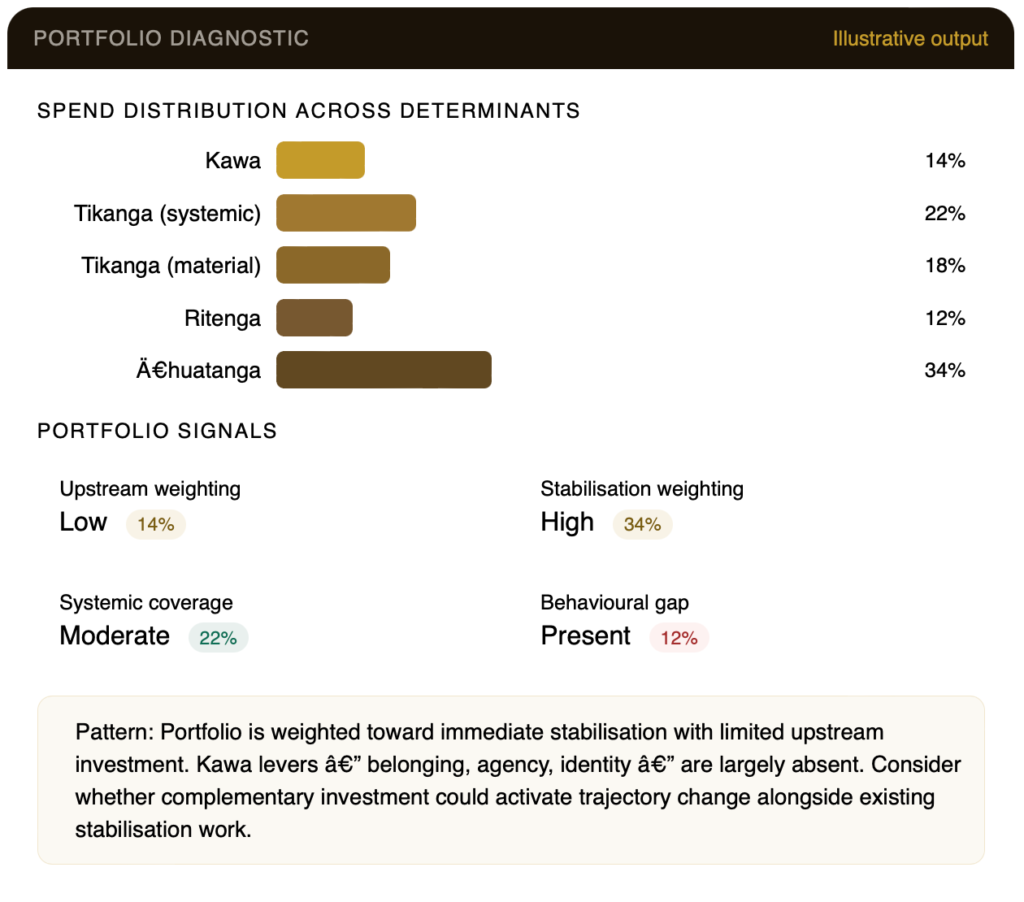
Move from asking what are we funding? to understanding what configuration of impact our portfolio is positioned to create. Map current investment across the Whiria Ngā Ara determinants, surface gaps and concentrations, and support more deliberate collective judgement about where effort should go.
Most organisations can analyse social impact investment by domain – health, housing, education – but struggle to see the impact potential of the portfolio as a whole. The portfolio allocation tool makes that visible, without requiring complex inputs or specialist analysis.
Users enter high-level information about what is currently funded and at what scale. The tool maps spend across determinants, identifies where the portfolio is clustered, thin or absent, and generates diagnostic views to support investment conversations.
01
Enter your portfolio
Tag current initiatives to determinants and levers. Simple, high-level inputs – no complex scoring required.
02
See the pattern
Diagnostic views show where spend sits, where it clusters, and what impact posture the current portfolio is likely to create.
03
Sense-make collectively
Use the outputs to support debate: hold course, rebalance, strengthen existing work, or seek partnership where no single actor can carry the change alone.
The tool does not rank investments as good or bad, or prescribe an ideal mix. In some communities a heavily downstream portfolio may be exactly right – meeting lived realities or filling a gap in the wider ecosystem. Judgement remains with governors, decision makers and communities. The tool makes the current pattern clear enough to be debated, tested and adjusted.
TOOL 02
Theory of change builder
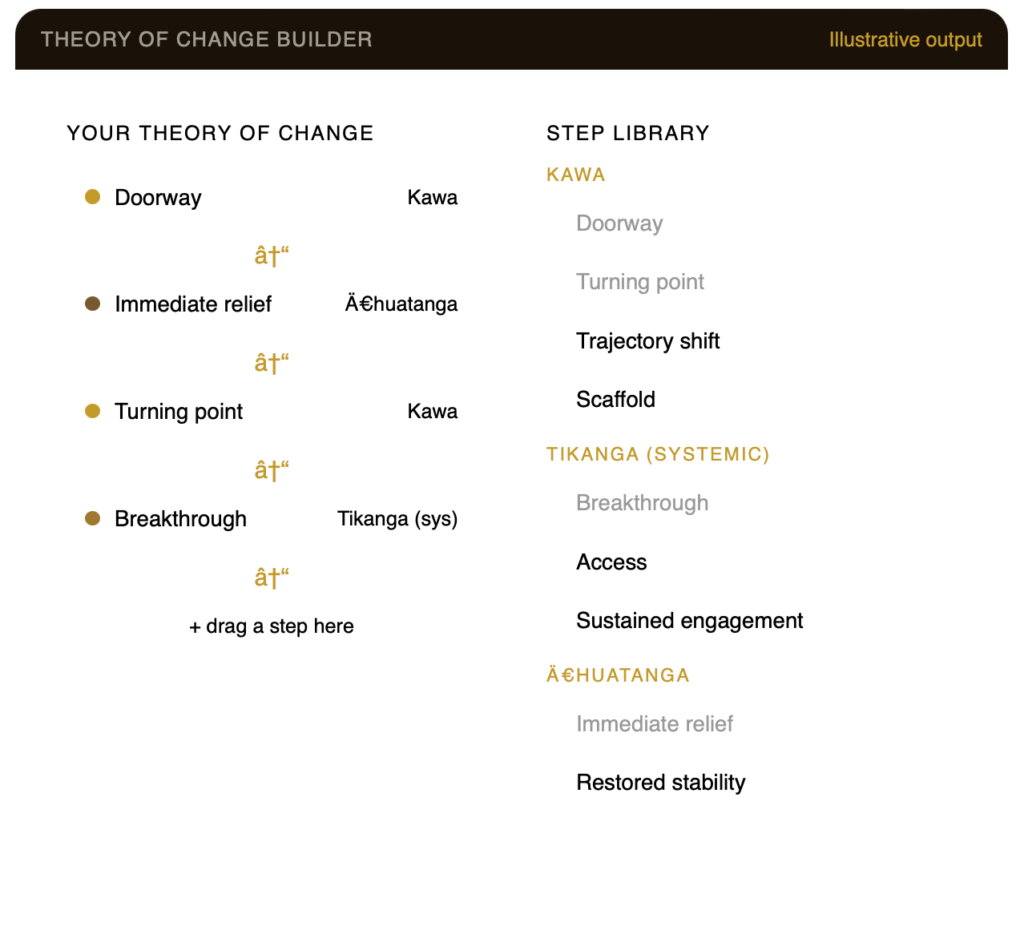
Build and test programme theories of change using plug-and-play causal steps from the Whiria Ngā Ara impact pathways. Start with an empirically informed scaffold rather than a blank page. Keep the underlying logic connected to a shared evidence base while adapting it to your context.
Most organisations are asked to produce theories of change from a blank page – debating language, trying to make indirect change look linear, and building bespoke indicator sets that don’t accumulate into shared learning. The theory of change builder offers a different starting point.
Practitioners select and arrange causal steps from the impact pathway library, mix steps across determinants, and test whether the pathway is strong enough to carry the intended impact using contribution mapping prompts.
01
Choose your pathway steps
Drag causal steps from the impact pathway library. Mix steps across Kawa, Tikanga, Ritenga and Āhuatanga to reflect how your programme actually works.
02
Arrange and connect
Order the steps, add parallel pathways, and name the mechanism that carries change from one stage to the next.
03
Test with contribution mapping
See which levers align to each step, where the pathway may be thin, and where small design changes could materially lift impact potential.
TOOL 03
Ecosystem Mapping
Shift the conversation from where is help needed? to where is our contribution most meaningful? Map the wider ecosystem of effort across a defined place, population, rohe or kaupapa – and see where the collective investment pattern creates gaps, duplication or opportunities for complementarity.
Social impact is rarely produced by one actor alone. Government agencies, Iwi and Māori organisations, community providers, NGOs, philanthropic investors, local groups and whānau all shape different parts of the landscape. When those efforts are not visible together, duplication grows, gaps stay hidden and opportunities for complementarity are missed.
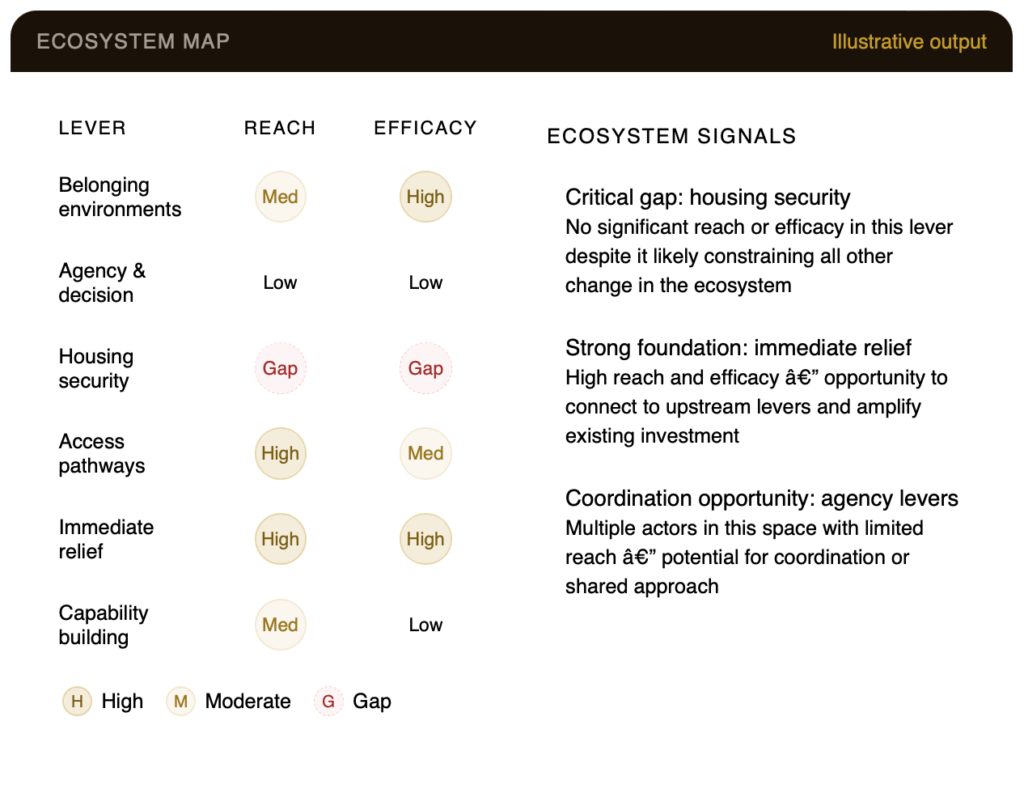
The ecosystem mapping tool allows analysts to tag initiatives across a defined area to Whiria Ngā Ara levers, assess reach and efficacy, and generate views that surface where effort is concentrated, where it is thin or absent, and where strong work could be amplified or complemented.
01
Tag initiatives to levers
Map all initiatives in a defined area – across all actors – to the relevant Whiria Ngā Ara determinants and levers.
02
Assess reach and efficacy
Rate each initiative on two dimensions: how many people it reaches and how well it appears to be working in this context. Precision matters less than surfacing patterns.
03
See the collective pattern
Diagnostic views show where the ecosystem is concentrated, where it is thin, and where your contribution is most meaningful relative to what else exists.
your data
Your data stays yours. Completely.
The Whiria Ngā Ara tools are built so that none of your data enters our systems. We have designed this deliberately, not as a default setting but as a foundational commitment.
No data enters our systems
Everything you enter – portfolio data, programme logic, ecosystem maps – is processed entirely within your browser session. Nothing is transmitted to or stored by us.
No tracking
We do not track how you use the tools, what you enter, or what outputs you generate. There are no analytics on your inputs, no session logging, and no use of your data to train or improve our models.
Full data sovereignty
Your investment data, community information and programme logic belong to you. You decide what to share, with whom, and on what terms. The tools support your governance – they do not create obligations to disclose.
This matters particularly for Iwi and Māori organisations working within kaupapa Māori data governance frameworks. The tools are designed to be consistent with tino rangatiratanga over your data – including alignment with Māori data sovereignty principles. If you want to talk through how the tools work technically, or what our data commitments mean in practice, please get in touch.
research partnership
Help us learn – and let us help you
Whiria Ngā Ara is a research-informed framework, and it gets stronger through use. We would genuinely value connecting with organisations using the tools – to understand what is working, where the architecture needs refinement, and how causal relationships play out in different contexts.
01
Light touch survey
After using the tools, we may invite you to complete a brief survey – a handful of questions about your experience, what was useful, and what could be improved. It takes a few minutes and helps us understand how the framework is landing in practice.
Participation is entirely optional. If you would prefer not to receive survey invitations, you can opt out at any point.
02
Research case study
A small number of organisations each year are invited to participate in a deeper case study as part of a funded research project. This is a genuine two-way exchange.
What you get
A written-up theory of change for your programme, with evidence consolidated and synthesised. Something concrete you can use to support funding applications, board reporting, and wider advocacy for your work.
What we get
A richer understanding of how the causal relationships in the architecture play out in practice — how determinants interact, what enables or disrupts pathways, and how the framework needs to evolve.
This is always your choice
Using the tools creates no obligation to participate in research. We will never share your organisation’s data or use your tool outputs without your explicit consent. Research participation – whether a brief survey or a full case study – is entirely voluntary and governed by standard research ethics protocols.
GET STARTED
Ready to use the tools?
All three tools are freely available from September 2026. Register your interest to be notified when they launch – or get in touch now if you would like to apply them ahead of the public launch or explore a research partnership.
Explore further
The tools are built on the Whiria Ngā Ara framework. Understanding the architecture makes the tools more powerful.
The framework
Understand the determinant groups, impact pathways and the evidence base that underpins the tools.
Applications
See how the tools have been applied with Hauora Māori Services Te Waipounamu and Pou Tangata.
Read the primer
The long primer sets out the full rational, architecture and methodology for those who want to dive deep.